Why Your Back Hurts After Golf (And What Your Body Is Trying to Tell You)
Why Your Back Hurts After Golf!
You finish a round feeling pretty good. Maybe even great.
Then the next morning you roll out of bed and your back immediately reminds you that you played golf yesterday.
I've heard this hundreds of times. "I love golf, but my back always pays for it." And this time of year it comes up constantly - the weather gets better, the days get longer, people start sneaking in extra holes after work or spending real time at the range again.
That's all great. Until the back starts talking.
Here's the thing most people get wrong: they blame the back. But your back is usually the victim, not the culprit.
Your back is doing work it was never supposed to do
The golf swing is a rotational movement. That rotation should mostly come from your hips and your upper back, with your core connecting everything in the middle. When those pieces are working together, the swing feels natural — almost easy.
When they're not working, your lower back fills in the gap.
And your lower back really wasn't built for that job. It can handle some rotation. It doesn't want to be the main engine for it. Do that for nine holes and it's fine. Do it for eighteen, three times a week, all spring and summer... and eventually something complains.
A lot of movement limitations stay hidden during the winter because you're simply not asking much from your body. Then spring comes. You start rotating hundreds of times a week. And now whatever wasn't moving well before has nowhere to hide.
What compensation actually looks like
The most common thing I see during assessments is limited hip mobility. The golfer can't rotate through their hips the way the swing demands, so the body improvises. The lower back rotates more. The shoulders overwork. Sometimes there's a sway instead of a true rotation.
The body is clever and it'll find a way to complete the movement no matter what. The problem is that compensation works right up until it doesn't. That's when the discomfort shows up. Not because golf is hard on your back, but because your back has been quietly covering for everyone else.
Why rest only gets you so far
Rest helps. Sometimes rest is exactly what you need. But rest doesn't fix the underlying reason it happened. If your hips aren't moving well, they'll still be limited when you come back. If your core isn't doing its job, it still won't be when you tee it up again.
That's how so many golfers end up in the same loop -- play, get sore, rest, feel better, play again, repeat. Nothing actually changes.
One exercise worth trying
My favorite for golfers dealing with back issues is the dead bug. I know, the name is not inspiring. And honestly it looks a little ridiculous. But it works.
The whole point is to teach your core to stabilize your spine while your limbs are moving -which is basically what it needs to do during every single swing. A lot of golfers are genuinely surprised by how hard it is when they slow down and do it right.
Try 8–10 slow reps per side. Don't rush through it. The control is the whole point.
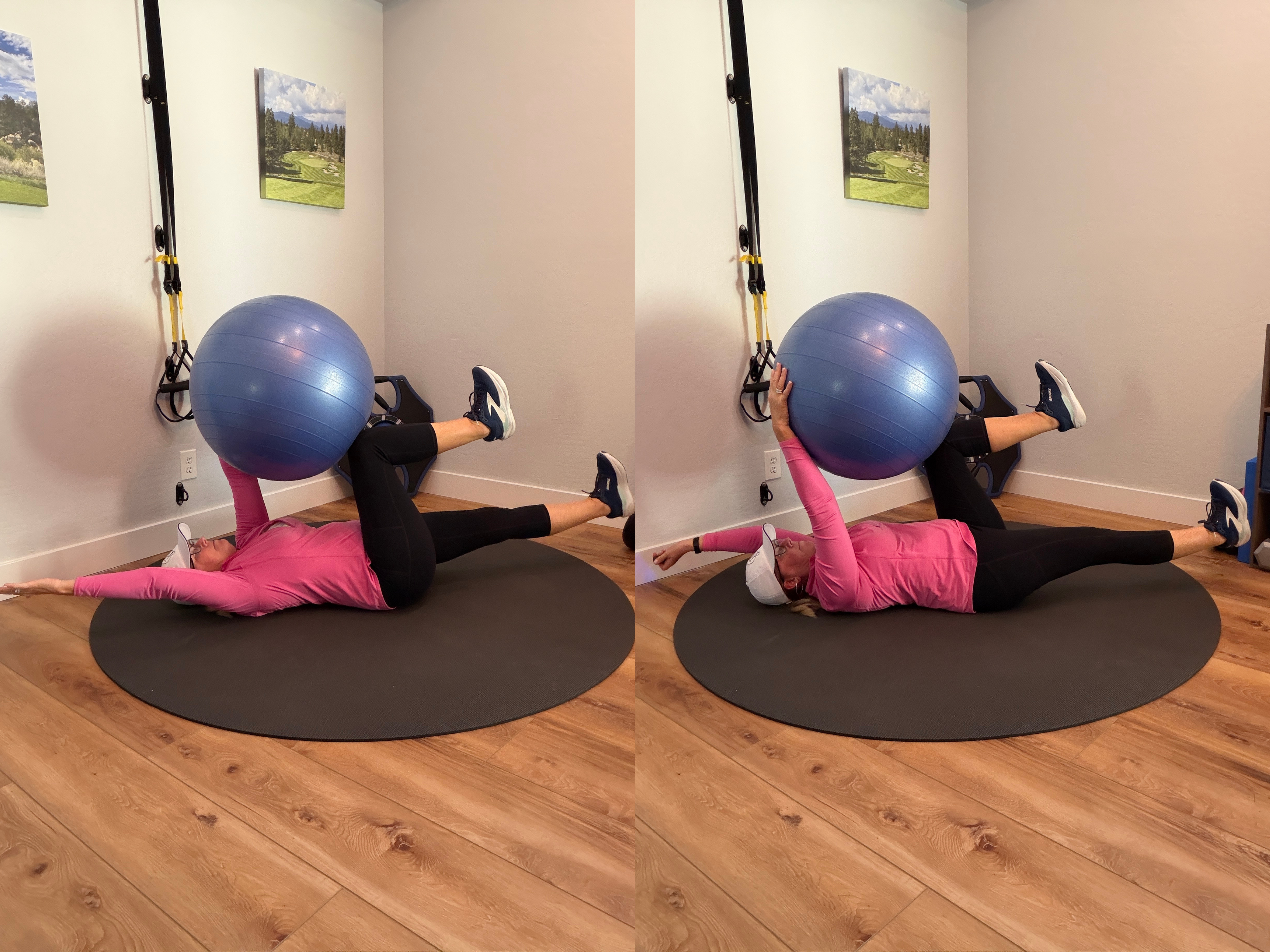
I like using a stability ball between my hands and knees. It makes you think a bit more.
Press your low-back into the floor, draw your abdominals in during this exercise. Adjust as needed.
Extend opposite arm/legs straight out - keeping your back flat the entire time. Keep arms and legs hovering above the floor. You can do all reps on one side or alternate sides during the reps.
What "getting better" actually feels like
It usually doesn't show up as more distance or lower scores first. It shows up as a swing that feels less like a fight. Golfers tell me things like "I don't feel like I'm grinding through it anymore" or "I played 18 and didn't even think about my back on the drive home."
That's the real sign things are moving in the right direction. A body that's doing what it's supposed to do and that's usually where better golf starts anyway.
If your back has been talking to you lately, don't just stretch it and hope for the best. Look at how your hips are moving. Look at whether your core is actually helping. Because sometimes your back doesn't need more attention - it needs less, once the right things start pulling their weight.
What do you notice first after a round — your back, your hips, something else entirely?
Let me know! I'd love to hear from you...
Make sure to check out the Fit for the Fairway Club! We're an online Golf Fitness Club! Come try us out for 7 Days!
Janis Thornton
